
How to rent a yacht in Singapore: step-by-step guide
Learn how to rent a yacht in Singapore with this step-by-step guide covering yacht types, booking tips, costs, and what to expect on charter day.
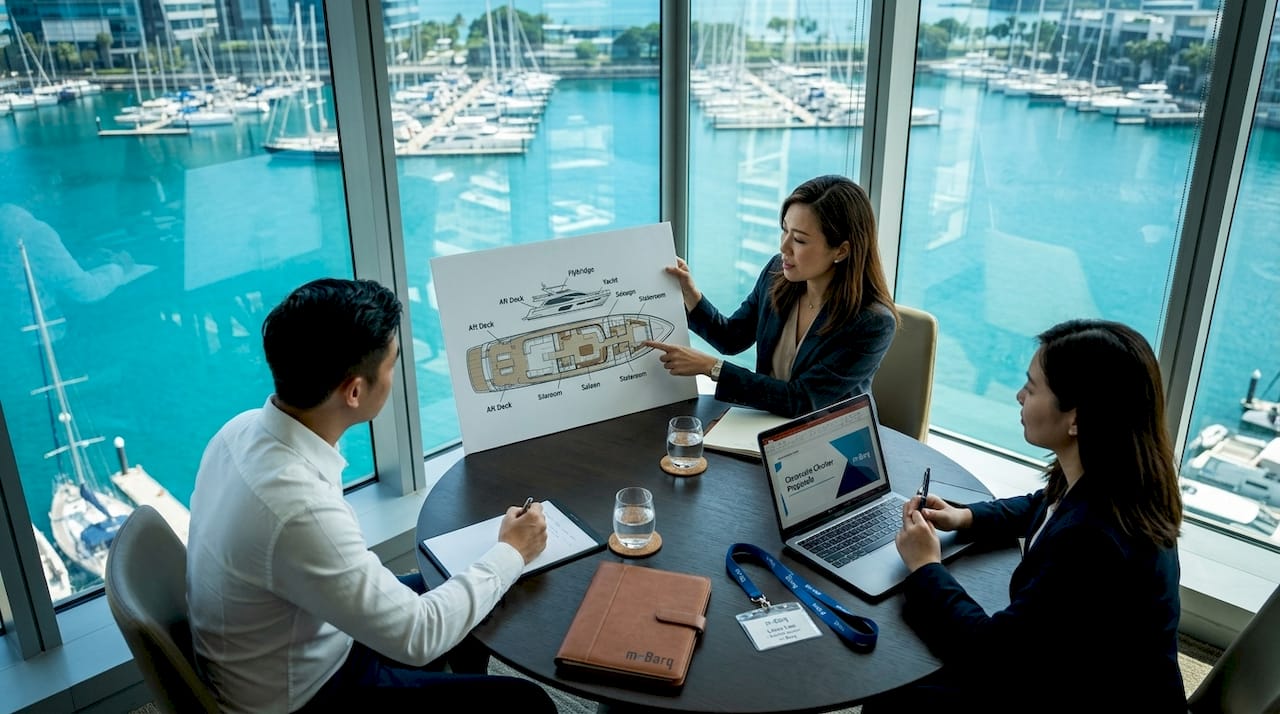
Planning a corporate yacht event in Singapore sounds exciting until someone mentions “APA,” “port side,” or “ready about” and you feel the confidence drain out of the room. You’re not alone. Most event planners encounter yachting terminology for the first time when reviewing charter contracts or coordinating with a crew, and that unfamiliar language can slow things down fast. This guide cuts through the jargon. We’ll walk you through the essential terms you actually need, from directional basics and sail components to contract vocabulary and water sports lingo, so your next event runs smoothly from departure to dock.
| Point | Details |
|---|---|
| Role of clear terminology | Using the right yachting terms improves guest safety and event coordination. |
| Event contract basics | Knowing terms like APA and MYBA helps planners manage quotes and avoid surprises. |
| Water sports lingo | Terms such as SUP and kayak relay are common in Singapore corporate yacht events. |
| Essential safety language | Crew briefings with clear terminology ensure all guests know what to do in any situation. |
| Focus on relevance | Planners only need to master terms most applicable to their type of event and yacht. |
Language is not just about sounding professional on the water. It is about safety, efficiency, and making sure everyone, guests, crew, and coordinators, is on the same page when it counts. When you understand the terms your crew uses, you can coordinate group activities more confidently and give clearer instructions during safety briefings.
Here’s why the language of yachting matters more than most event planners realize:
“The moment an event planner speaks the crew’s language, the whole dynamic shifts. Suddenly it’s a collaboration, not just a hire.”
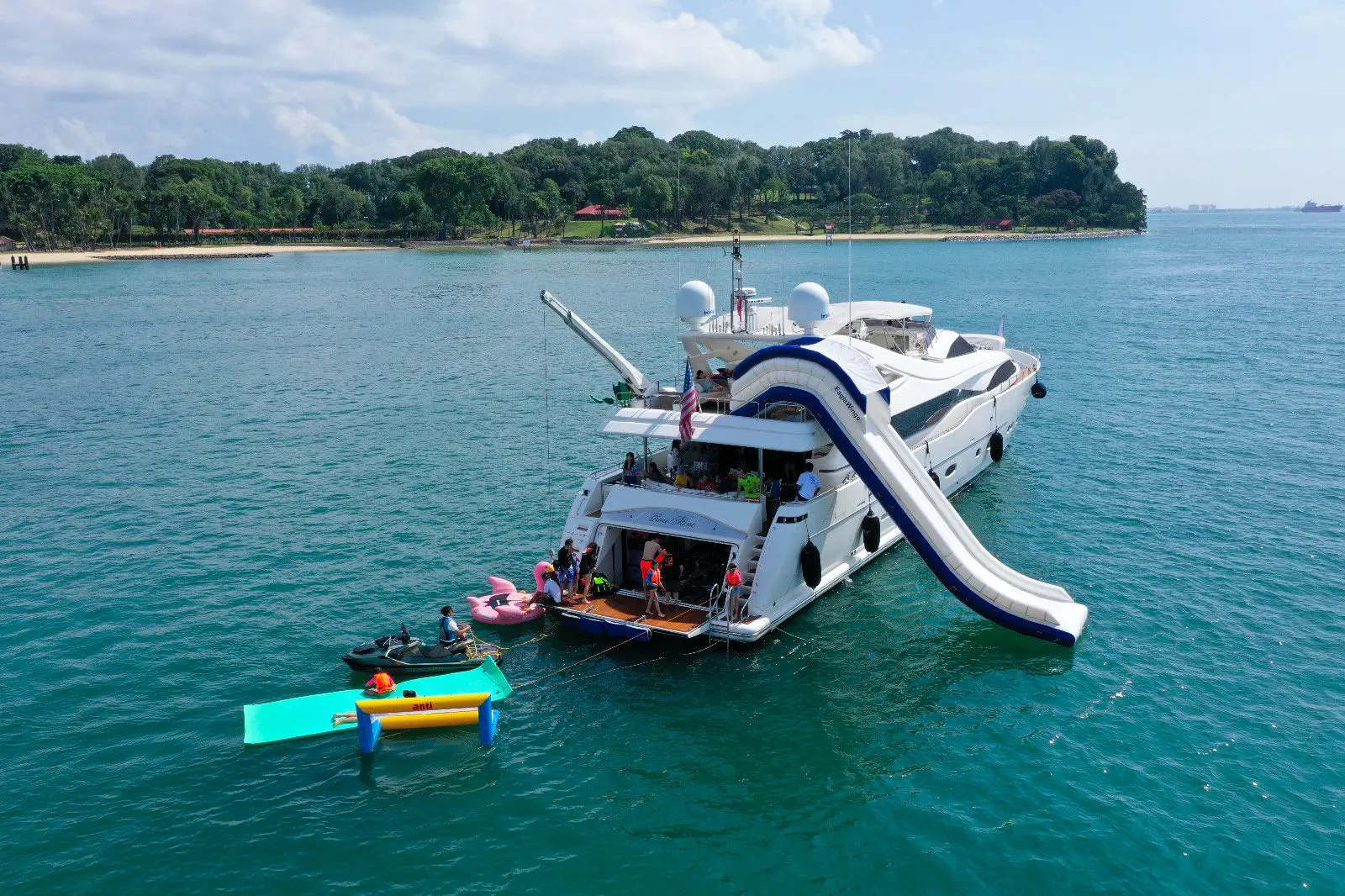
When you’re exploring corporate yacht event options in Singapore, you’ll notice that charters typically cruise to Lazarus Island or St. John’s Island where the yacht anchors and guests enjoy the water. Knowing the language helps you coordinate these moments effortlessly.
Pro Tip: Before your event day, spend 15 minutes reviewing key terms with your internal team. It takes little time and prevents a lot of confusion on the water.
Every yacht has its own geography. Once you learn how to navigate that geography with words, coordinating guests and crew becomes intuitive. Let’s break it down.
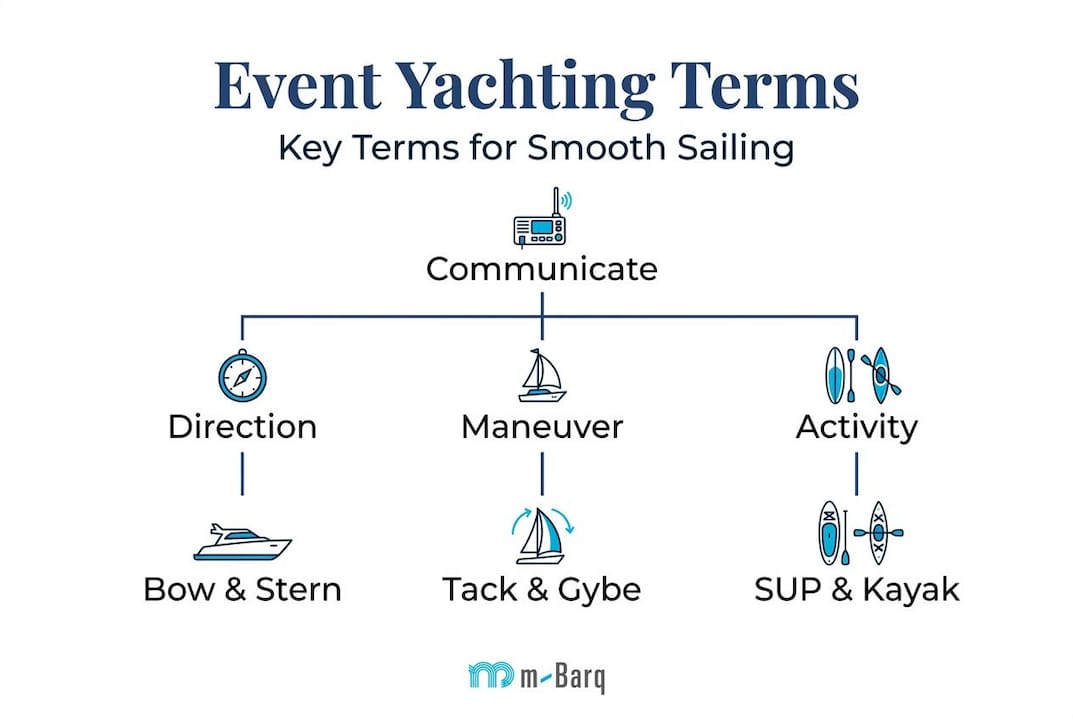
Directional terms are the foundation. Core yachting terminology includes:
| Term | Meaning | Practical use |
|---|---|---|
| Bow | Front of the yacht | “Guests gather at the bow for photos” |
| Stern | Rear of the yacht | “Water toys launch from the stern” |
| Port | Left side facing forward | “Kayaks on the port side” |
| Starboard | Right side facing forward | “Board from the starboard ladder” |
| Beam | Widest part of the vessel | “Stay inboard of the beam during maneuvers” |
Sail and rigging terms matter more on sailing yachts, but knowing them adds credibility and context when speaking with crews. Sail and rigging components include the mainsail (the primary sail attached to the mast and boom), the jib or genoa (the foresail positioned in front of the mast), the halyard (the line used to hoist sails), the sheet (the line that controls the angle of a sail), and the boom (the horizontal spar that holds the foot of the mainsail).
Maneuvers you might hear about during a corporate charter include:
For most Singapore corporate charters heading to Lazarus Island or St. John’s Island, you won’t be executing complex maneuvers. The crew handles all of that. But knowing these terms means you can ask smart questions during planning calls and understand any safety guidance the captain provides.
Pro Tip: Share a simple one-page glossary with your guests before the event. Terms like “bow,” “stern,” “port,” and “starboard” make safety briefings quicker and more engaging.
If you’re new to all of this, our first-time yacht charter guide covers the full process from booking to boarding, and it’s built specifically for Singapore.
This is where many event planners feel the most pressure. Yacht charter contracts come with their own shorthand, and missing the meaning of even one term can affect your budget or your event flexibility. Let’s decode the most important ones.
Key contract terms:
Activity-specific terms for Singapore corporate charters:
| Activity | Abbreviation or term | What it involves |
|---|---|---|
| Stand-up paddleboarding | SUP | Guests balance and paddle on a board in calm waters |
| Kayaking relay | Kayak relay | Team-based race or challenge in two-person kayaks |
| Water mat | Float mat | Large inflatable platform for group relaxing or games |
| Water slide | Deck slide | Inflatable slide mounted to the yacht’s deck or stern |
Singapore team-building charters commonly run for 4 to 6 hours with groups of 10 to 40 guests. Activities like SUP and kayaking build team coordination without requiring any sailing knowledge from participants. They’re fun, inclusive, and naturally energizing.
You can explore full details of available yacht water sports options or look into different event charter formats depending on your group size and objectives.
Pro Tip: Always ask your broker to clarify whether water sports equipment is included or billed separately. This single question can prevent billing surprises after a great day on the water.
When reviewing any contract, pay close attention to the force majeure clause. Singapore’s weather can shift quickly, especially between May and November during the southwest monsoon season. A clear cancellation or rescheduling policy protects both you and your guests.
Knowing the words is one thing. Using them well during your event is what actually makes the difference. Here’s how to integrate terminology into your briefings and group activities in a way that feels natural and confident.
Steps for a smooth onboard safety briefing:
“A well-run safety briefing is the first moment guests realize this isn’t just a boat trip. It’s a premium, professionally managed experience.”
For team-building activities specifically, using event-appropriate language keeps the energy high. Call it a “SUP relay challenge” instead of just “paddleboarding.” Frame the kayaking as a “stern-to-buoy sprint.” These small naming choices make activities feel like part of a curated program rather than a casual afternoon.
Pro Tip: Give your team-building challenges names before the event. Creative activity names tied to nautical language, like “Port vs. Starboard Relay,” boost excitement and make the event more memorable.
Discover more about what makes team-building on yachts so effective for corporate groups, and why the combination of open water and shared challenges creates bonds that office-based activities rarely achieve.
Here’s a perspective most guides won’t give you: you don’t need to master every yachting term to run a brilliant corporate event. And trying to do so may actually distract you from what matters most.
The misconception we see often is that event planners feel they need to become sailing experts before they feel confident booking a charter. They spend time learning about gybing angles and halyard rigging when what they really need to know is far simpler: bow, stern, port, starboard, APA, and man overboard. That’s the working vocabulary that actually affects your event.
Motor yachts, which are most common for Singapore corporate charters, prioritize guest comfort and water amenities over sailing maneuvers. Sailing yachts involve more rigging vocabulary and active crew work. For the majority of corporate groups heading to Lazarus Island for a day of SUP, kayaking, and the water slide, the rigging terms are interesting background knowledge but not operationally critical.
What is critical is your ability to communicate clearly with your crew during planning, to read your contract with confidence, and to brief your guests with authority on the day. That’s a focused, practical skill set and it’s entirely learnable before your event.
Our experience tells us that the planners who make the best impression on their guests are not the ones who know the most terminology. They’re the ones who know exactly which terms to use, and when. A confident “everyone to the stern for the water toys” lands so much better than a hesitant “um, the back of the boat.”
Focus on your event type, learn the terms that apply to it, and let the crew handle everything else. That’s the real approach for unique yacht event approaches that feel effortless and professional.
Understanding yachting terminology is a genuine confidence booster, but you don’t have to figure it all out on your own.
At m-Barq, we specialize in making corporate yacht events feel easy from the first inquiry to the last wave goodbye. Whether you’re planning a team-building day at Lazarus Island with kayaking and SUP relays or a sunset celebration with the full water slide setup, we handle every detail. From matching you with the right yacht to coordinating the crew briefing, all you need to do is show up. Explore our corporate yacht charter options to see what’s available for your group, check out our team-building experiences to build the right program, or simply browse our full fleet and tell us what you have in mind.
A tack turns the bow through the wind while a gybe turns the stern through the wind. A gybe carries more risk due to the boom swinging forcefully across the deck, which is why the crew calls “stand by to gybe” as a warning.
The most useful terms for guests are bow, stern, port, and starboard for navigation, plus the safety phrase “man overboard” so everyone knows how to respond in an emergency. These six concepts cover 90 percent of what a guest will ever need to know.
No. Most Singapore corporate charters focus on water sports and group activities at anchor, not complex sailing. The crew manages all navigation while your guests enjoy kayaking, SUP, and the water slide at the island.