
How to rent a yacht in Singapore: step-by-step guide
Learn how to rent a yacht in Singapore with this step-by-step guide covering yacht types, booking tips, costs, and what to expect on charter day.
When you book a yacht for a corporate event in Singapore, the temptation is to assume the captain has everything covered. He doesn’t. The role of yacht manager is an entirely separate function, and confusing the two is one of the most common and costly mistakes corporate planners make. Yacht managers handle the technical, financial, compliance, and crew-side operations from shore, so that by the time your guests step aboard for an evening cruise around Lazarus Island, every single detail is already locked in. This guide breaks down exactly what yacht managers do and why that matters for your next upscale corporate gathering on the water.
| Point | Details |
|---|---|
| Yacht management scope | Yacht managers handle technical, financial, crew, and compliance tasks essential for smooth yacht operations and event success. |
| Captain vs yacht manager | Captains manage onboard navigation and safety, while yacht managers handle shore-side coordination and administration. |
| Crew management essentials | Tracking certifications, payroll, and performance ensures professional, compliant crew service during corporate events. |
| Financial oversight importance | Budgeting, invoice approvals, and regular owner reporting maintain financial transparency and control. |
| Corporate event value | Professional yacht management mitigates risk, enhances safety, and ensures seamless luxury corporate gatherings on the water. |
Now that you understand why yacht management is more complex than many assume, let’s explore the specific responsibilities yacht managers take on.
At the center of every well-run yacht operation is a yacht manager who acts as the connective tissue between owners, captains, crew, vendors, and event planners. Think of them as a project manager, compliance officer, HR lead, and finance controller rolled into one shore-based role. For corporate yacht charters, this coordination is not a luxury. It’s what makes events actually work.
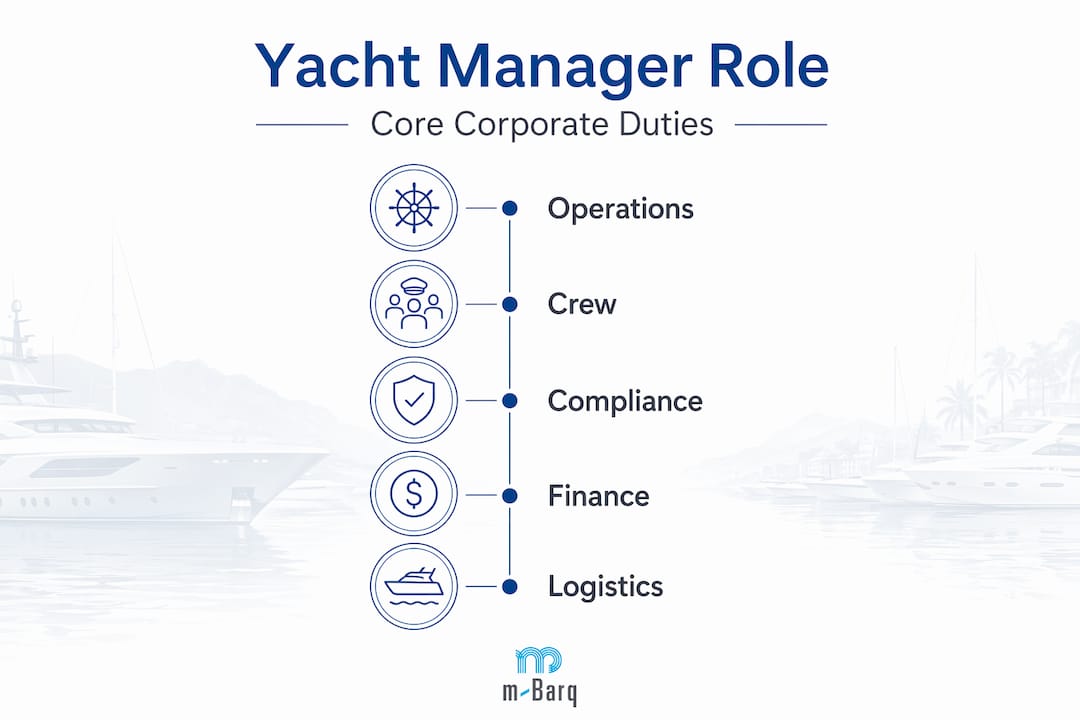
Yacht managers oversee safety and compliance administration, technical and emergency support, crew management, financial administration, and shoreside support, serving as the central point of contact and reporting to owners regularly. That’s a wide mandate, and each area feeds directly into your event’s success or failure.
Here’s a breakdown of the core responsibilities a yacht manager holds:
When these functions are executed well, your guests simply arrive at the marina, step aboard, and enjoy the ride out to anchor off St. John’s Island. When they’re not, the cracks show fast.
Technical oversight is where yacht managers quietly prevent disasters that most planners never even hear about. Yacht management companies coordinate maintenance schedules, crew payroll, regulatory compliance, financial management, and new-build supervision, typically handling four core areas: technical, operational, administrative, and financial, especially for yachts over 24 meters where self-management becomes genuinely complex.
For an upscale corporate event, the technical layer matters enormously. Here’s what yacht managers actively manage on this front:
For yacht investment insights, understanding this technical layer also helps owners appreciate what proper management protects against: unplanned costs, regulatory fines, and reputational damage.
Pro Tip: Before confirming any corporate charter, ask whether the vessel has a dedicated yacht manager or relies solely on the captain for compliance and maintenance. The answer tells you a lot about the operational risk you’re taking on.
With the technical and compliance landscape set, let’s examine how yacht managers ensure the right crew delivers impeccable service during your corporate events.
Your guests will not remember the engine specs. They will remember whether the crew was professional, attentive, and genuinely warm. Yacht managers coordinate all captain and crew employment procedures, ensure certifications are verified, manage crew payroll, oversee annual appraisals, and track training renewals essential for both compliance and service quality. This is what makes consistently great hospitality possible, especially when you’re hosting 30 executives on a yacht anchored off Lazarus Island.
The crew management process follows a clear sequence:
Pairing excellent crew with thoughtfully planned yacht catering services creates the kind of experience your guests actually talk about back at the office.
Pro Tip: For corporate events with 20 or more guests, always confirm that crew certifications are current and appropriate for your headcount. The requirements change above certain passenger thresholds, and a yacht manager will already know exactly what applies.
Understanding crew management highlights how yacht managers support flawless hospitality. Now let’s clarify the financial and administrative functions they handle.
Full-service yacht management fees follow a pass-through model where the management company charges a coordination fee while actual crew salaries and operational expenses are billed at cost. Budgets are prepared annually with mid-year reviews and monthly reporting to owners. For corporate event planners, this structure means you get real financial transparency with no hidden surprises buried in a flat rate.
Here’s what financial administration actually looks like in practice:
| Financial function | When it happens | Why it matters for your event |
|---|---|---|
| Annual budget preparation | November each year | Sets the financial framework for the charter season |
| Mid-year budget review | June each year | Adjusts forecasts based on actual spend and upcoming bookings |
| Monthly expenditure monitoring | Ongoing | Prevents cost overages and flags unusual expenses early |
| Invoice approvals | Per transaction | Ensures vendor quality and prevents unauthorized charges |
| Contract coordination | As needed | Covers insurance, vendors, communications, and service providers |
| Owner reporting | Monthly or quarterly | Provides economic analysis and flags potential savings |
The benefits of yacht rental for corporate use become even clearer when you understand that a well-managed vessel comes with financial accountability built in. You’re not just renting a boat. You’re accessing a professionally run operation with documented financial controls.
Beyond budgets, yacht managers also coordinate contracts with insurers, catering vendors, marine communications providers, and specialized event suppliers. Every agreement tied to your event runs through them, which protects quality and keeps accountability in one place.
Having covered financial and administrative oversight, let’s bring these components together for Singapore’s luxury corporate event market specifically.
Singapore’s maritime environment is tightly regulated and highly professional. Running a corporate yacht event here means navigating local port authority requirements, international maritime law, and the elevated expectations of executives who spend their working lives holding vendors to exceptional standards. Professional yacht management addresses all of it.
“The key difference is captains handle onboard decisions while yacht managers from shore ensure technical, financial, and compliance aspects without operational overlap.” — Stuart Ribton, Southern Right Yachting
Owners often assume that hiring a captain covers full management, but true management requires documented processes for hull surveys, crew payroll, insurance renewals, and compliance. Without these, yachts can become unsafe and non-compliant quickly, and that risk does not belong anywhere near a corporate event.
Here’s what professional yacht management delivers specifically for corporate events in Singapore:
Here’s a perspective we’ve formed after coordinating many upscale events on Singapore waters: most corporate planners spend enormous energy on the visible elements of an event — the food, the playlist, the branded merchandise — while almost none of it goes toward understanding the operational infrastructure underneath. That’s where yacht managers quietly determine whether your event succeeds or falls apart.
The audit process yacht managers conduct during ownership or charter vessel transitions is a perfect example. Preparing handover documents one to two months ahead prevents the kind of surprises that derail events: expired certificates, unresolved maintenance items, or crew employment gaps that only surface when it’s too late.
For corporate charters, managers handle guest vetting, provisioning logistics, and turnaround planning between events, often within a 24 to 48-hour window. Many planners skip this detail entirely, assuming it will sort itself out. It doesn’t.
There’s also a common misconception worth addressing directly. Separating the captain’s role from the yacht manager’s role is not bureaucratic overhead. It’s actually what makes the captain better at their job. When a captain isn’t simultaneously worried about insurance renewals and crew payroll, they can focus entirely on safe navigation, guest safety, and delivering an exceptional experience on the water. The yacht manager handles corporate team building on yachts logistics from shore while the captain runs the show on deck. That’s the ideal setup.
Pro Tip: Engage with your yacht manager at least four weeks before a corporate event. The earlier you align on provisioning, headcount, activity scheduling, and crew briefings, the smoother the day flows.
Pro Tip: Ask for a written summary of the vessel’s current compliance status before you finalize your booking. Any professionally managed yacht should have this ready within 24 hours.
You’ve just seen the full scope of what goes into professionally managed yacht operations. The good news? You don’t have to coordinate any of it yourself.
At m-Barq, we specialize in corporate yacht charters in Singapore where every technical, crew, compliance, and logistics detail is handled for you. From matching you with the right luxury vessel to managing water activities at Lazarus Island and St. John’s Island, we take care of the full operation. Our team brings yacht investment guidance for owners and premium event coordination for planners, all under one roof. Explore our full range of luxury yacht rentals and let’s build an event your guests will genuinely remember.
A yacht manager oversees all operational, technical, financial, crew, and compliance aspects, ensuring the yacht is safe, legal, and event-ready so planners can focus entirely on guest experience. Yacht managers cover safety and compliance administration, technical and emergency support, crew management, financial administration, and shoreside support.
The captain handles navigation, onboard safety, and daily operations, while the yacht manager manages shore-side administration, financials, maintenance, and crew employment. The key distinction is that captains handle safe operation and on-board decisions while yacht managers provide oversight on technical, financial, administrative, and compliance matters from shore.
Tracking ensures every crew member meets international standards, which is especially important for events with 20 or more guests where regulatory thresholds change. Managers track STCW renewals required every five years to maintain compliance and protect guests throughout the charter.
A yacht manager prepares annual budgets, conducts mid-year reviews, monitors monthly expenditures, approves invoices, and delivers regular reports to owners. Budgets are prepared annually with structured mid-year reviews and monthly reporting cycles that keep spending transparent and controlled.
Yacht managers coordinate provisioning, guest vetting, crew scheduling, vessel maintenance, and turnaround planning between events to prevent delays and maintain standards. Turnaround planning between events typically runs within a 24 to 48-hour window, a logistical detail many planners overlook until it causes problems.